
 Tiếng Việt
BingX rebate calculation is the process of estimating how much trading fee cashback a user may receive after eligible trades. In most cases, the calculation is based on actual paid trading fees multiplied by a rebate percentage, not on the full trading volume.
Next, fees matter because they are the base number in the calculation. If the trading fee is low, the estimated rebate will also be lower, even when the rebate percentage looks attractive.
Besides that, the formula gives users a simple way to estimate cashback before expecting a payout. A common way to understand it is: Actual Paid Trading Fees × Rebate Percentage = Estimated Rebate.
Finally, percentage decides how much of the paid fee may come back as rebate. This rate can depend on referral code, partner rules, campaign terms, account eligibility, or rebate voucher conditions. Below, CashbackCoin explains the full logic in a clear and practical way.
Contents:
What Is BingX Rebate Calculation?
BingX rebate calculation is the method used to estimate trading fee cashback based on eligible fees, rebate percentage, and campaign or referral conditions.

This idea matters because many users confuse rebate with bonus, fee discount, voucher, or referral commission. To understand the real amount that may return to the account, users need to separate trading volume, trading fee, and actual paid fee.
What Does BingX Rebate Mean?
BingX rebate means a partial return of trading fees after eligible trading activity. It can appear through referral programs, partner campaigns, rebate vouchers, or platform events.
For example, if a trader pays a trading fee and the account qualifies for a rebate program, part of that fee may be returned based on the applicable percentage. BingX also explains that rebate vouchers are used for trading fee rebates and are issued after transactions.
This is different from a general sign-up bonus. A bonus may support trading activity, while a rebate is more closely connected to fees generated from completed trades.
Why Users Need To Understand Rebate Calculation
Users need to understand rebate calculation because the same trading volume can create different rebate amounts.
For example, two users may both trade 10,000 USDT. However, if one pays 5 USDT in fees and another pays 8 USDT, their estimated rebate will not be the same. The result can also change when one user has a different fee tier, referral code, partner rate, or campaign condition.
This is why CashbackCoin recommends checking the fee base first before calculating any expected cashback.
BingX Rebate Calculation vs Cashback vs Fee Discount
BingX rebate calculation, cashback, and fee discount are related but not identical.
Rebate or cashback usually means a portion of trading fees is returned after a trade. Fee discount usually means the fee is reduced before or during the transaction. In contrast, a rebate voucher may offset trading fees under specific rules.
This difference is important because a user may see “discount,” “rebate,” and “voucher” in different places and assume they produce the same final amount. In reality, the final rebate may depend on whether the calculation uses gross fee, discounted fee, or actual paid fee.
Thus, before applying any formula, users should first confirm whether they are receiving cashback, a fee discount, or a voucher, because the next step is to identify the actual trading fees used as the rebate base.
How Trading Fees Affect BingX Rebate Calculation
Trading fees affect BingX rebate calculation because fees are usually the main base used to estimate rebate value.

In simple terms, higher eligible fees can create higher potential rebates, but only when the rebate percentage and account conditions support that result.
Trading Fees as the Base of Rebate Calculation
Trading fees are the base of rebate calculation because rebate is usually connected to fees paid, not the full order value.
For example, if a user trades 10,000 USDT and pays 5 USDT in trading fees, the rebate should be estimated from the 5 USDT fee, not from the 10,000 USDT trading volume.
This point is essential for beginners. Trading volume may look large, but the actual fee is much smaller. Therefore, the cashback amount is also smaller than many users first expect.
CashbackCoin usually explains this with a simple rule: volume creates fees, but fees create rebate. For users learning how to get rebate on BingX, understanding this fee-based logic is the first step before checking rebate percentage or campaign conditions.
Maker Fee and Taker Fee
Maker fee and taker fee can affect rebate because they may create different actual paid trading fees.
A maker order usually adds liquidity to the order book, while a taker order usually removes liquidity by matching immediately. Because these order types can have different fee levels, they can also produce different rebate estimates.
For example, a market order may create a taker fee, while a limit order may become a maker order if it waits in the order book. When the fee type changes, the base number in the rebate formula can also change.
This means users should not only ask “What is the rebate percentage?” They should also ask “What fee did my trade actually generate?”
Spot Trading Fees vs Futures Trading Fees
Spot trading fees and futures trading fees can affect rebate calculation because each product may use a different fee structure.
Spot trading usually involves buying and selling crypto assets directly. Futures trading involves contract-based trading and may include more frequent position opening and closing. Because of this, futures users may generate fees more often, especially if they trade actively.
However, higher activity does not automatically mean better rebate. The final number still depends on actual paid fees, rebate percentage, and eligibility.
For a practical approach, CashbackCoin suggests separating rebate estimates by trading product:
| Trading Type | Fee Base To Check | Why It Matters |
| Spot Trading | Spot maker/taker fee | Useful for asset buying and selling |
| Futures Trading | Futures maker/taker fee | Important for frequent contract trading |
| Copy Trading | Related trading fees | May depend on copied trade activity |
This table shows that each trading type should be checked with its own fee logic before estimating rebate.
Actual Paid Fees After Discount
Actual paid fees after discount are important because some rebate calculations may use the net fee actually paid by the user.
For example, if the original fee is 10 USDT but a discount reduces it to 8 USDT, the rebate may be calculated from 8 USDT depending on the program rule. BingX partner documentation also refers to commission income based on net actual trading fees after already rebated amounts.
This is one of the most important details in BingX rebate calculation. Users who ignore fee discounts may overestimate their cashback.
Therefore, users should check the actual fee record first, because this fee becomes the main input for the BingX rebate calculation formula explained in the next section.
BingX Rebate Calculation Formula Explained
The BingX rebate calculation formula is Actual Paid Trading Fees × Rebate Percentage = Estimated Rebate.

This formula gives users a fast way to estimate cashback, but it should be used with current campaign terms and actual account records.
Basic BingX Rebate Formula
The basic formula is:
BingX Rebate = Actual Paid Trading Fees × Rebate Percentage
Each part has a specific meaning:
- Actual Paid Trading Fees: the real fee paid after discounts or eligible deductions.
- Rebate Percentage: the percentage applied by a referral, partner, voucher, or campaign.
- Final Rebate: the estimated amount that may be returned.
For example, BingX partner guidance describes referral commission using actual paid trading fees multiplied by a commission ratio. While user rebate and partner commission are not always the same thing, the logic helps explain why actual paid fees are central to calculation.
Simple Example of BingX Rebate Calculation
A simple BingX rebate calculation example is:
- Trading fees paid: 100 USDT
- Rebate percentage: 20%
- Estimated rebate: 100 × 20% = 20 USDT
In this case, the user may estimate a 20 USDT rebate if the trade, account, and campaign all qualify.
However, the result should still be treated as an estimate. If the rebate program uses net actual paid fees, excludes some products, or has a cap, the final amount may be lower.
Rebate Calculation Based on Different Fee Levels
The table below shows how estimated rebate changes when trading fees increase while the rebate percentage stays the same.
| Trading Fees | Rebate Percentage | Estimated Rebate |
| 10 USDT | 20% | 2 USDT |
| 50 USDT | 20% | 10 USDT |
| 100 USDT | 20% | 20 USDT |
This table shows a simple pattern: when the fee base increases, the estimated rebate increases proportionally.
However, users should not assume that the percentage is always 20%. The real rate may depend on referral setup, partner rate, voucher value, campaign rules, or account eligibility.
Common Mistakes When Using the Formula
The most common mistake is calculating rebate from trading volume instead of trading fees.
For example, a user may trade 10,000 USDT and expect rebate from the full 10,000 USDT. This is incorrect. Rebate is usually linked to the trading fee generated from that volume.
Other common mistakes include:
- Using a fixed rebate percentage without checking current campaign rules.
- Ignoring maker and taker fee differences.
- Forgetting that fee discount may reduce the actual paid fee base.
- Confusing rebate voucher with withdrawable cashback.
- Assuming all trading products qualify for the same rebate rate.
CashbackCoin recommends using the formula only after confirming the actual paid fee, because the next factor that directly changes the final result is the valid rebate percentage.
BingX Rebate Percentage and Factors That Affect It
BingX rebate percentage is the rate used to decide how much of eligible trading fees may return as rebate.
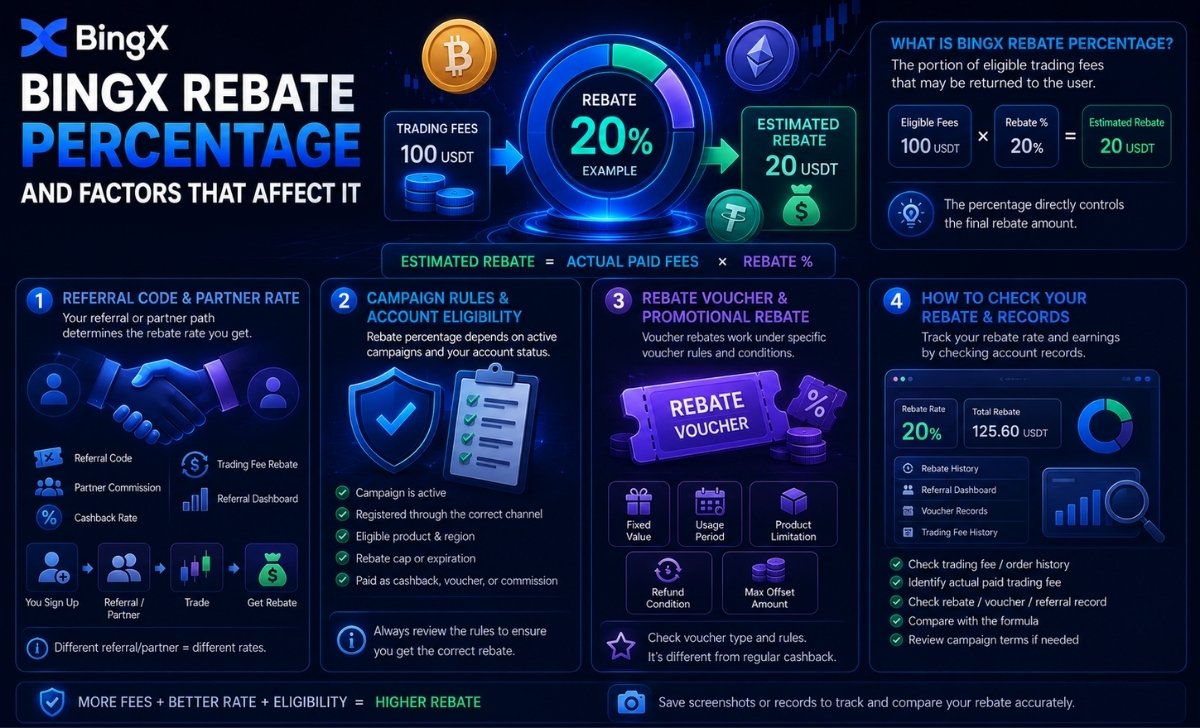
This percentage is not always fixed. It can change based on referral setup, partner program, campaign rules, voucher type, and account conditions.
What Is BingX Rebate Percentage?
BingX rebate percentage is the portion of eligible trading fees that may be returned to the user.
For example, if the rebate percentage is 20% and eligible trading fees are 100 USDT, the estimated rebate is 20 USDT.
Users who compare BingX Cashback with regular trading fee rebates should understand that the final amount still depends on the eligible fee, rebate percentage, and campaign conditions.
This percentage is powerful because it directly controls the final result. Even when two users pay the same fees, their rebate can be different if their percentage rates are different.
Referral Code and Partner Rate
Referral code and partner rate can affect rebate because they may determine which campaign or commission-sharing structure applies to the account.
BingX’s referral-related materials explain that users may receive trading fee rebates after signing up and trading through certain referral settings. This means the referral path can matter when users want rebate benefits.
For SEO and user clarity, this section should naturally connect these terms:
- BingX referral code
- Partner commission
- Cashback rate
- Trading fee rebate
- Referral dashboard
CashbackCoin can position itself as a practical guide for users who want to understand whether a referral setup may influence their rebate calculation.
Campaign Rules and Account Eligibility
Campaign rules and account eligibility can affect BingX rebate percentage because not every account or trade may qualify for the same rate.
Some campaigns may apply only to new users. Others may depend on region, product type, trading volume, voucher status, or registration channel. A user who joins through one partner campaign may see a different structure from another user.
This is why users should avoid assuming that one advertised percentage applies forever. The better approach is to check:
- Whether the campaign is still active.
- Whether the account registered through the correct channel.
- Whether the product traded is eligible.
- Whether the rebate has a cap or expiration.
- Whether the rebate is paid as cashback, voucher, or commission share.
The clearer these conditions are, the more accurate the calculation becomes. Before users withdraw BingX cashback, they should review these conditions carefully to make sure the recorded rebate matches the expected calculation.
Rebate Voucher and Promotional Rebate
A rebate voucher is different from regular cashback because it may be used to offset trading fees under specific voucher rules.
BingX explains that rebate vouchers can be used for trading fee rebates and that users may receive refunds on trading fees after completing trades with eligible vouchers.
This means voucher-based rebate may not work like a standard ongoing cashback rate. It may have:
- A fixed voucher value.
- A usage period.
- A product limitation.
- A refund condition.
- A maximum offset amount.
BingX also distinguishes bonus, rebate voucher, and trial fund voucher, noting different usage purposes such as trading margin, trading fees, or funding fees.
Therefore, users should check whether they are calculating a normal rebate percentage or a voucher-based refund.
How To Check Your Rebate Percentage and Records
Users can check rebate percentage and records by reviewing account rewards, rebate history, referral dashboard, partner dashboard, or voucher records.
The exact location may vary depending on the account type and campaign. However, the goal is the same: confirm what fee was paid, what percentage applied, and what amount was returned.
A practical checking process includes:
- Open the trading fee or order history.
- Identify the actual paid trading fee.
- Check the rebate, voucher, or referral record.
- Compare the recorded rebate with the estimated formula.
- Review campaign terms if the number does not match.
CashbackCoin recommends saving screenshots or transaction records when tracking rebate manually. This helps users compare expected rebate and actual rebate more accurately.
Conclusion
BingX rebate calculation helps users understand how trading fees, formula, and percentage work together to estimate cashback.
In simple terms, users should remember this logic: actual paid trading fees create the fee base, the rebate percentage decides the return rate, and campaign rules determine eligibility. When these three elements are clear, the estimated rebate becomes much easier to understand.
CashbackCoin helps users understand crypto cashback, rebate calculation, referral benefits, and exchange fee logic in a simple way. Visit CashbackCoin to explore more practical guides before calculating or comparing exchange rebates.

Darian Velmott is a Crypto Cashback Program Specialist at CashbackCoin, specializing in crypto cashback programs, trading fee rebates, referral rewards, and exchange cost optimization. He focuses on helping traders understand cashback opportunities across major exchanges including Binance, BingX, Bitget, Bybit, and Gate.io. His content covers cashback activation, rebate tracking, fee discount analysis, reward conditions, and practical guides for crypto traders.